
The United States betting landscape has always been a dynamic, high-stakes environment, but a seismic shift is currently underway. While the explosion of mobile sports wagering has dominated the headlines for years, a new, more expansive type of financial speculation is taking center stage with the official return of Polymarket. After a two-year regulatory hiatus in the U.S., the prediction market platform, Polymarket, has officially rolled out its mobile and web application to American customers. This development is not merely the reentry of one company; it signals the maturing and mainstreaming of the entire prediction market industry, driven by the innovative model of Polymarket.
This report breaks down the unique offering of Polymarket, explains the economics of prediction markets, details the regulatory saga that led to its brief U.S. ban, and analyzes the profound implications of a multi-billion dollar platform like Polymarket gaining official U.S. approval.
What is a Prediction Market? The Theory Behind Polymarket
To understand the magnitude of Polymarket’s influence, one must first grasp the concept of a prediction market. At its core, a prediction market is an exchange-traded market created for the purpose of trading contracts that predict the outcome of future events. These markets operate on the “wisdom of the crowd” principle, aggregating decentralized information into a single, quantifiable probability.
Unlike opinion polls or surveys, which only capture stated intent, prediction markets capture actual commitment, as participants are required to wager real money on their belief. The core function of Polymarket is to provide a liquid and efficient platform for this information aggregation. Polymarket allows users to buy and sell shares whose value is determined by the probability of an event happening, whether that is the result of an election, the release date of a video game, or a financial metric hitting a certain threshold.
The key to the pricing model on Polymarket lies in the simple, yet elegant, structure of the shares.
The Mechanics of Trading on Polymarket
Polymarket operates as a cryptocurrency-based platform, utilizing blockchain technology to ensure transparency, security, and decentralized settlement. This structure is integral to the platform’s operation.
On Polymarket, every market is defined by a simple, binary outcome: “Yes” or “No.” Users buy and sell shares in the outcome, always priced between $0.00 and $1.00.
How the Pricing Works: The share price of a “Yes” contract directly corresponds to the market’s perceived probability of that outcome occurring.
- A share price of $0.50 means the market believes the event has a 50% chance of happening.
- A share price of $0.80 means the market gives the event an 80% chance of happening.
- A share price of $0.20 means the market gives the event only a 20% chance of happening.
If the event occurs (the “Yes” outcome is confirmed), the shares for that outcome settle at $1.00, while the “No” shares settle at $0.00. If the event does not occur (the “No” outcome is confirmed), the “No” shares settle at $1.00, and the “Yes” shares settle at $0.00.
Consider a market on Polymarket asking: “Will the Kansas City Chiefs win the next NFL Championship?”
- A user buys 100 “Yes” shares at $0.50 each. Total cost: $50.
- If the Chiefs win, the “Yes” shares settle at $1.00. The user’s payout is $100, resulting in a $50 profit.
- If the Chiefs lose, the “Yes” shares settle at $0.00. The user loses their $50 investment.
Crucially, the share price on Polymarket is determined solely by the buying and selling activity of the participants, reflecting the dynamic consensus of the crowd. This is a vital difference from traditional gambling and gives Polymarket its unique informational value.
Polymarket vs. The Sportsbook: A Peer-to-Peer Revolution
The resurgence of Polymarket in the U.S. is directly challenging the established dominance of traditional sports betting giants like DraftKings and FanDuel. The core difference lies in the financial and operational model.
1. The Financial Model (P2P vs. The House):
- Polymarket (Peer-to-Peer): Polymarket acts as an exchange. Participants are betting against each other, not against the platform. The platform collects a small fee from the winning trades but does not profit from users’ losses. The market prices are determined by the collective behavior of the traders.
- Traditional Sportsbooks (Bookmaker): The sportsbook sets the odds (or the “lines”) and manages the risk. They actively adjust these odds to balance their books, ensuring they profit regardless of the outcome. Losing wagers go directly to the house.
2. The Market Scope:
- Polymarket: The scope is virtually limitless. While sports are included, the majority of trading volume on Polymarket often revolves around politics (“Who will be the next Speaker of the House?”), finance (“Will the S&P 500 close above 5,500 by year-end?”), and culture (“Will a specific music album drop next month?”). This is a prediction market for information, not just entertainment.
- Traditional Sportsbooks: Markets are generally restricted to sports results and explicitly approved, regulated events.
The peer-to-peer exchange model of Polymarket is what makes it such a powerful tool for aggregating collective human knowledge. The price of a share on Polymarket is not an arbitrary odd set by an analyst; it is a real-time reflection of the capital commitment of thousands of informed (and uninformed) traders.
The Regulatory Saga: Why Polymarket Was Banned—And Why It Returned
The path to U.S. acceptance for Polymarket has been fraught with challenges. In 2022, the U.S. Commodity Futures Trading Commission (CFTC), the agency that regulates commodities and futures markets, took action against Polymarket. The CFTC contended that Polymarket was illegally offering off-exchange binary options to U.S. customers. Binary options are regulated financial contracts, and the CFTC viewed the “Yes/No” shares traded on Polymarket as falling into this category. The result was a cease-and-desist order and a fine, leading to Polymarket being blocked from serving U.S.-based customers.
This 2022 ban forced Polymarket to pivot and focus on achieving regulatory compliance, a journey that its main U.S. competitor, Kalshi, had successfully navigated earlier. The recent, landmark approval received by Polymarket from the CFTC marks a significant moment. It legitimizes the platform’s new operational model and confirms that Polymarket can now legally operate in the U.S., offering its wide range of markets to American citizens. This move is a powerful endorsement of the platform’s stability and regulatory adherence. The ability of Polymarket to successfully navigate this complex regulatory terrain demonstrates its commitment to long-term operations in one of the world’s largest financial markets.
The Economic Impact: A $9 Billion Valuation and Mass Participation on Polymarket
The market capitalization and trading volumes associated with Polymarket are staggering, illustrating its immense influence.
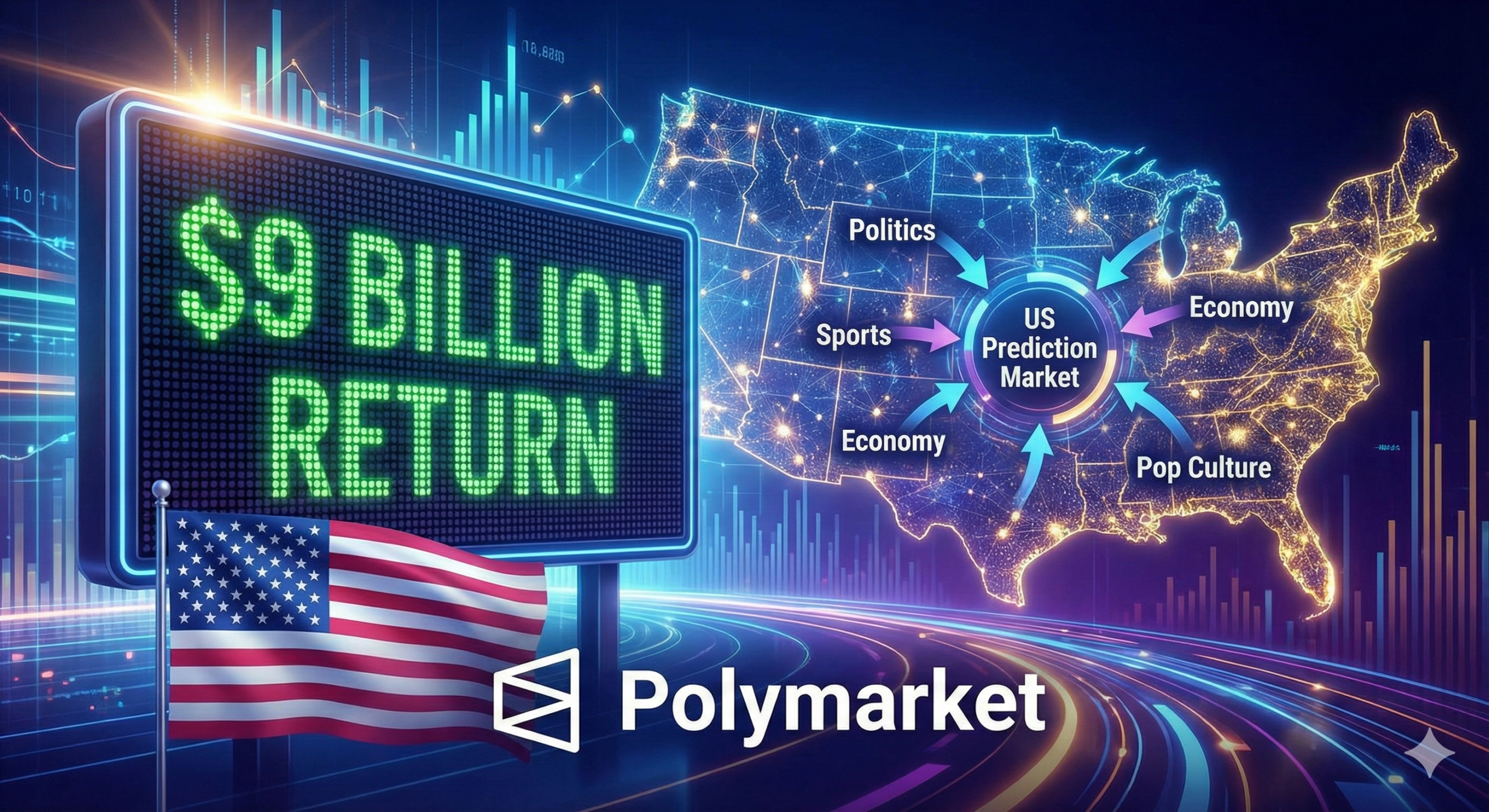
$9 Billion Valuation
Founder Shayne Coplan, a 27-year-old college dropout, recently confirmed on 60 Minutes that Polymarket has achieved a valuation of $9 billion. This figure places Polymarket firmly among the most significant emerging financial technology companies globally. The valuation is not just based on the potential of prediction markets, but on the proven track record of Polymarket to attract liquidity and mass participation.
Mass Wagers on Polymarket
The 2024 U.S. presidential election served as a pivotal moment for Polymarket, showcasing its capacity to handle massive volumes. A total of $3.6 billion was reportedly wagered on Polymarket for the outcome of that single political event. This dwarfs the volume seen on almost any single sports event and underscores the platform’s role as a major barometer for public—and informed—opinion on political matters. The ability of Polymarket to facilitate such large-scale, high-stakes trading solidified its reputation and attracted institutional interest.
The significant liquidity and activity on Polymarket is what makes it so valuable. When a market attracts millions or billions of dollars, the resulting share price becomes an incredibly accurate, real-time forecast of the event’s outcome, often surpassing traditional polling and expert analysis.
The Future: Competition and Collaboration for Polymarket
The return of Polymarket to the U.S. market sets the stage for a new competitive era.
Firstly, traditional sportsbooks are not ignoring the success of Polymarket. Recognizing the appeal of wagering on non-sports events, major players like DraftKings and FanDuel have announced plans to launch similar prediction-style products in the coming months. This confirms that the model pioneered by Polymarket is now seen as an essential component of the modern betting and financial ecosystem.
Secondly, Polymarket has proactively sought high-profile partnerships. The collaboration between Polymarket and TKO, the parent company of the UFC, announced in November, highlights the platform’s ambition to integrate its unique market model with mainstream entertainment and sports. This first-of-its-kind deal suggests that Polymarket is positioning itself not just as a prediction market, but as a crucial source of public sentiment and predictive data for major organizations.
In conclusion, the U.S. launch of Polymarket marks a tipping point. The platform, with its robust, peer-to-peer, crypto-based model, has successfully overcome regulatory hurdles and proven its massive scale. As it competes with and influences traditional sportsbooks, Polymarket is poised to continue its role as the definitive marketplace for real-time collective wisdom, cementing its $9 billion valuation and reshaping how the world makes—and trades—predictions.