
The prediction market platform Polymarket has garnered massive attention for its ability to aggregate global sentiment into real-time, tradable probabilities across politics, finance, and culture. But for any user to trust a financial platform—especially one that handles billions of dollars in wagers—the most critical component is the payout process. It must be fast, accurate, transparent, and immutable.
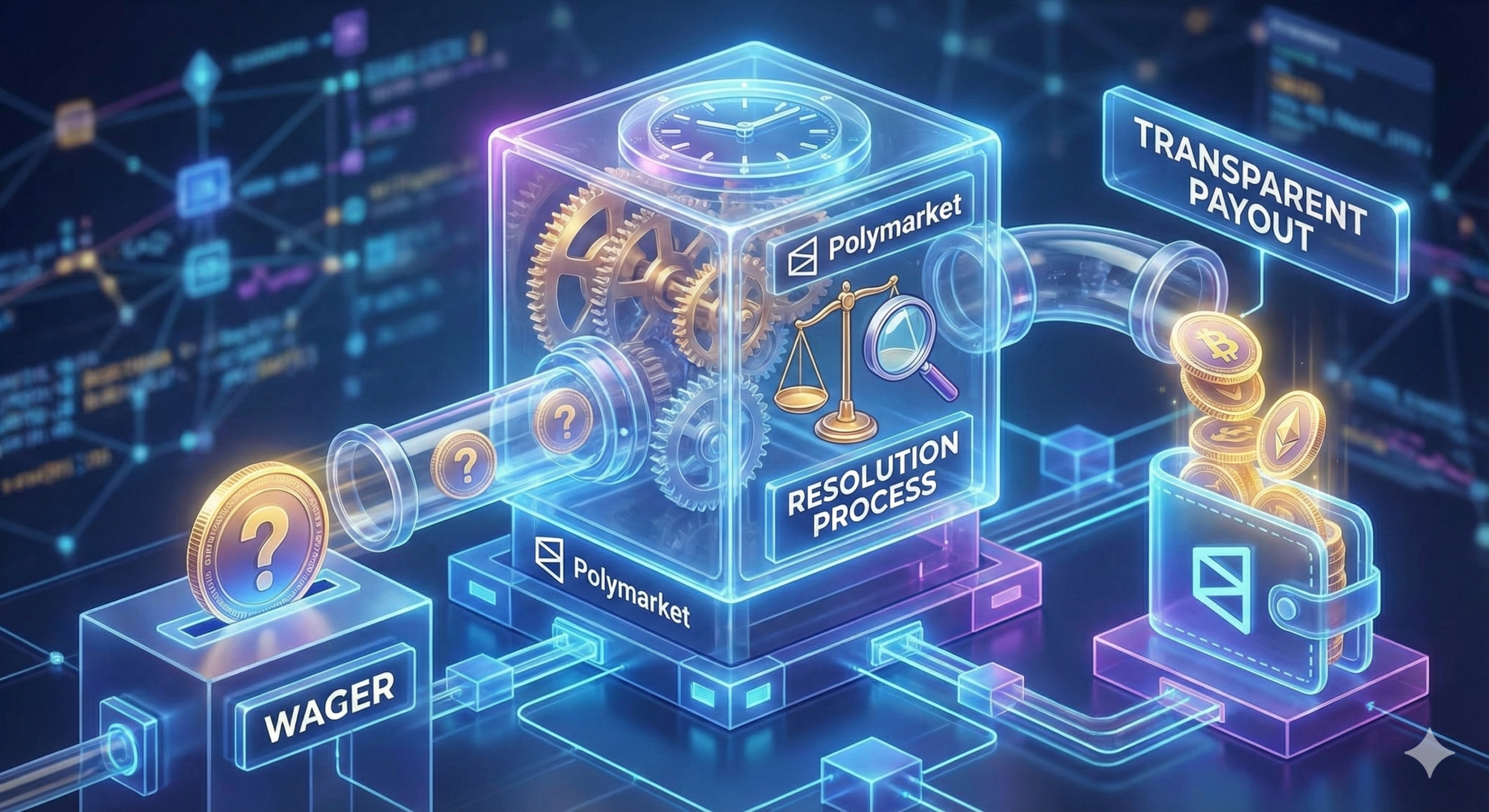
The genius of the Polymarket payout system lies in its use of decentralized technology, which eliminates the need for a central authority to manually confirm results or distribute funds. Unlike traditional sportsbooks where the “house” handles all settlements, the payouts on Polymarket are executed by automated smart contracts on the blockchain, governed by a robust, community-driven oracle system.
This article breaks down the entire journey of a wager on Polymarket, from the moment a market closes to the final withdrawal of profits into a user’s wallet.
I. The Fundamental Payout Rule: Shares Settle at $1.00
The foundation of the Polymarket payout mechanism is simple math combined with an ironclad financial contract. Every market on Polymarket is binary, structured with “Yes” and “No” outcome shares. The total value of one “Yes” share plus one “No” share always equals $1.00 USDC. This is because every share pair is backed by $1.00 in collateral.
The Settlement Mechanism: Once the real-world event concludes and the outcome is verified, the settlement process is triggered:
- Winning Shares: The shares corresponding to the correct outcome immediately settle at $1.00 USDC each.
- Losing Shares: The shares corresponding to the incorrect outcome become worthless (settle at $0.00).
For example, if you bought 1,000 “Yes” shares predicting a company’s stock price would hit a certain target at a price of $0.30, your initial cost was $300. If the event happens, your 1,000 winning shares are automatically redeemed for $1,000, resulting in a $700 profit. This payout is a guarantee enforced by the smart contracts that govern Polymarket.
II. The Integrity Engine: Market Resolution via Decentralized Oracle
The most crucial step in the payout process is determining the definitive, unambiguous outcome of the event. On Polymarket, this vital task is handled not by a centralized committee, but by a decentralized entity known as the UMA Optimistic Oracle (Universal Market Access).
Step 1: Proposal and Bond
When a market’s outcome is clear (e.g., an election result is certified), any user can step forward to propose a resolution.
- The proposer submits a resolution (e.g., “Market X resolves to YES”).
- They must put up a bond in USDC (typically around $750, though variable). This bond serves as a financial guarantee of their confidence and honesty.
Step 2: The Challenge Period
Once a proposal is made, a 2-hour challenge window begins. This is the community’s built-in safeguard against inaccurate or malicious resolutions.
- During this period, any participant who disagrees with the proposed outcome can dispute the resolution by posting a challenge bond equal to the proposer’s bond.
- If no one challenges the proposal within the 2-hour window, the resolution is accepted, the market is finalized, and payouts are initiated. The proposer receives their bond back plus a reward for their service.
Step 3: Dispute Resolution (The Oracle Vote)
If a proposed outcome is challenged, the resolution is escalated to the full UMA Decentralized Autonomous Organization (DAO) via its token holders. This is where the decentralized integrity of Polymarket is fully deployed.
- The dispute enters a debate period (typically 24–48 hours) where evidence and rationales are submitted.
- UMA token holders then vote on the correct outcome. The system is economically designed so that voting for the objectively correct answer is always the most profitable action, ensuring accuracy.
- The vote outcome is final, resolving the market and triggering the correct payout. The losing proposer or disputer forfeits their bond, which is used to reward the correct party and DAO voters.
This multi-layered system, enforced by the blockchain, ensures that the market resolution on Polymarket is immutable and cannot be tampered with by any single entity, including the platform itself.
III. The Currency and Network: USDC on Polygon
A core architectural decision for Polymarket was the choice of both its transaction currency and its operating blockchain network, decisions driven entirely by the goal of fast, low-cost payouts.
The Currency: USDC Stablecoin
All trading and payouts on Polymarket are denominated in USDC (USD Coin). USDC is a stablecoin pegged 1:1 to the U.S. dollar, backed by audited reserves.
- Stability: Using USDC eliminates crypto volatility. A share priced at $0.75 always means 75 cents, ensuring the focus remains on the predicted probability, not on the fluctuations of Bitcoin or Ethereum.
- Collateral: Winning shares pay out $1.00 USDC, guaranteeing the dollar value of the profit realized on Polymarket.
The Network: Polygon (Layer-2)
Polymarket is built primarily on the Polygon blockchain, a Layer-2 scaling solution for Ethereum.
- Low Fees: The primary benefit of using Polygon is the drastic reduction in transaction costs, often called “gas fees.” Trading on Polymarket is virtually free, and even deposits and withdrawals incur extremely minimal network fees compared to the main Ethereum chain. This makes trading high volumes of small positions profitable and accessible.
- Speed: Polygon offers much faster transaction throughput than the main chain, meaning that once the oracle resolves a market, the smart contracts can execute the payouts almost instantaneously.
This combination of USDC and Polygon allows Polymarket to offer a user experience far superior to many legacy financial platforms—near-instantaneous settlement and withdrawal of profits.
IV. Cashing Out: The Simple Withdrawal Process
Once a market has resolved and the winning shares have settled at $1.00, the profits are immediately reflected in the user’s account on Polymarket. The final step for the user is moving the USDC out of the platform and into their private crypto wallet or back to a traditional financial account.
The withdrawal process from Polymarket is designed to be frictionless:
- Navigate to Funds: The user visits the dedicated “Funds” or “Wallet” page within the Polymarket application.
- Initiate Withdrawal: They select the “Withdraw” option.
- Specify Address: The user must input a compatible crypto wallet address that supports USDC on the Polygon network. This step is crucial, as sending funds to an incompatible address can result in permanent loss.
- Confirm Amount: The amount of USDC to be withdrawn is entered.
- Instant Execution: The withdrawal is executed by the smart contract and sent to the specified wallet almost instantly, typically arriving in minutes or even seconds due to the efficiency of the Polygon network.
It is important to note that Polymarket** itself does not charge any fees for withdrawals**. The only costs involved are the minimal network (gas) fees required to process the transaction on the Polygon blockchain.
V. Transparency, Liquidity, and the Zero-Fee Model
The payout architecture of Polymarket is closely linked to its unique business model, which maximizes user profitability.
- Zero Trading Fees: Polymarket has adopted a zero trading fee model, a significant competitive advantage over competitors who charge up to 1% or more, and a radical departure from the 4–5% house edge common at traditional sportsbooks. By eliminating platform fees on trades, Polymarket encourages higher trading frequency and deeper market liquidity, making the market price (and thus the underlying probability) even more accurate.
- Blockchain Transparency: Every trade, the locking of collateral, the market resolution, and the final payout are all recorded on the public Polygon blockchain. This provides an immutable, auditable record for every transaction and resolution, ensuring that the platform’s operations are completely transparent. No user has to simply trust the platform; they can verify the outcome and payment via the blockchain explorer.
- Liquidity Rewards: To ensure there is always capital available for payouts, Polymarket incentivizes users to become liquidity providers (market makers) by offering them rewards (paid in USDC) for placing limit orders and maintaining tight bid-ask spreads. These rewards further lubricate the system, ensuring that when the market resolves, winning participants can cash out their settled $1.00 shares immediately.
In summary, the payout process on Polymarket is a masterpiece of modern fintech, blending the stability of the U.S. dollar with the speed and transparency of decentralized finance. It is a three-part machine: the smart contract guarantees the final $1.00 settlement, the UMA Oracle system ensures the integrity of the resolution, and the Polygon blockchain enables instant, low-cost withdrawal in USDC. This robust, peer-to-peer approach is why the return of Polymarket is considered a revolutionary moment for the entire prediction market industry.